The Kitchen Behind the Wall: How Hiding the Cook Became a Thing of the Past
For decades, the swinging door was the most important architectural feature in the American restaurant. It separated two completely different worlds — the polished, candlelit dining room where guests sipped wine and made conversation, and the chaotic, hot, clanging reality of the kitchen behind it. You could hear the noise when a server pushed through. You might catch a brief glimpse of stainless steel and white aprons. But the kitchen itself remained hidden, and that was entirely by design.
Nobody questioned it. The arrangement made a certain kind of intuitive sense. You went to a restaurant to enjoy a meal, not to watch it being assembled. The mystery was part of the appeal.
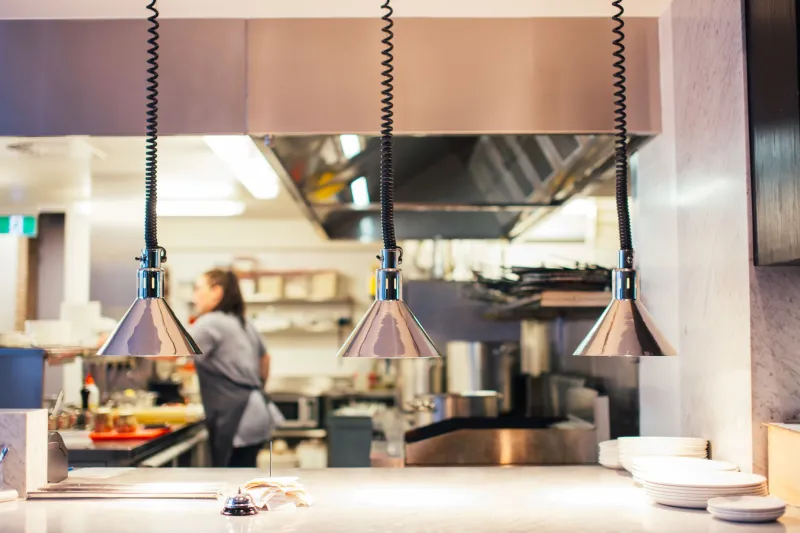
Now walk into almost any restaurant that opened in the last decade and you'll likely be able to see straight into the kitchen from your table. The wall is gone. The cooks are visible. The flames are part of the ambiance. And the shift tells you something interesting about how fundamentally American expectations around food, trust, and experience have changed.
When the Back of House Stayed Back
The closed-kitchen model dominated American dining for most of the twentieth century, and it wasn't accidental. It reflected a specific philosophy about hospitality — that a guest's job was to relax and receive, not to witness the labor involved in serving them. The kitchen was like the engine room of a ship. Essential, powerful, but not somewhere passengers needed to go.
This arrangement also carried an implicit social contract. You trusted the restaurant. You didn't need to see the process because the finished plate was the proof. A good meal arrived at your table, you enjoyed it, you paid, and the mechanism that produced it remained comfortably invisible. Questioning what happened back there wasn't rude exactly, but it wasn't really done.
For most diners, that trust held. They weren't thinking about food safety protocols or sourcing or whether the line cook had washed his hands. They were thinking about the chicken piccata.
The Transparency Shift
Something started changing in the late 1990s and accelerated sharply through the 2000s. A combination of forces — the rise of the Food Network, a growing cultural obsession with chef celebrity, and a broader consumer movement toward knowing where things came from — began eroding the old model.
Chefs who had spent careers invisible behind swinging doors suddenly became public figures. Shows like Iron Chef and later Top Chef turned cooking into performance art, something to be watched and judged in real time. If you could watch a chef compete on television, why couldn't you watch one cook your dinner?
Restaurants began experimenting with open kitchen designs, initially as a novelty and then, rapidly, as an expectation. The logic was straightforward: if your kitchen looked good and your cooks worked clean, showing it off was smart marketing. If you had something to hide, the closed door suddenly looked suspicious in a way it never had before.
Food safety scandals — some high-profile, some quietly damaging — reinforced the shift. Americans who had happily trusted the wall for generations started wondering what was on the other side of it.
When the Kitchen Became the Show
By the 2010s, the open kitchen had moved from trend to default. New restaurant construction almost universally incorporated some version of it. Exposed ranges, visible prep stations, chefs plating dishes in full view of the dining room — these became markers of a certain kind of credibility. The message was clear: we have nothing to hide, so we're hiding nothing.
But something else happened alongside the transparency movement, and it's worth examining honestly. The open kitchen didn't just satisfy consumer demand for accountability. It became a design aesthetic, a marketing tool, and eventually a content opportunity. Flames visible from the dining room photograph beautifully. A chef leaning over a pass, tweezers in hand, finishing a plate — that's an Instagram moment. The kitchen stopped being purely functional and became part of the theatrical experience of dining.
This is where the shift gets complicated. Transparency and performance are related but not identical. A kitchen designed to be seen is also a kitchen designed to look good being seen. The aesthetic decisions — the copper pots, the open shelving, the wood-fired oven positioned for maximum visibility — are choices made with the audience in mind. Which is fine, but it's worth recognizing that "open" and "honest" aren't quite the same thing.
What the Wall Was Really Hiding
Here's the interesting question: what did the closed kitchen actually represent, beyond just a design convention?
In part, it reflected a professional culture that valued craft over spectacle. The kitchen was where the real work happened, and real work doesn't always look pretty. Line cooking is physically demanding, occasionally brutal, and rarely cinematic. The separation of dining room from kitchen preserved a kind of dignity for both sides — guests got a curated experience, and cooks got to work without being watched.
The open kitchen changed that dynamic in ways both good and complicated. Greater visibility has genuinely raised standards in some places — it's harder to cut corners when the dining room can see you. But it's also created pressure on kitchens to perform as well as produce, which is a different kind of demand entirely.
A Table With a View
What American diners want from a restaurant has always reflected something broader about what they want from the businesses they patronize. The era of the closed kitchen was also an era of institutional trust — you didn't need to see how your bank managed your money, how your insurance company calculated your premium, or how your food was prepared. You trusted the system.
The open kitchen arrived alongside a general erosion of that trust and a corresponding demand for visibility. Show me the sourcing. Show me the process. Show me the kitchen. The wall came down not just because chefs wanted to show off, but because diners stopped being comfortable not knowing what was on the other side.
The swinging door is still out there in some restaurants, still separating the polished front from the working back. But it feels like a relic now — a design choice that requires justification in a way it never used to. The world shifted, and the kitchen moved with it, right out into the open where everyone could see.