The Bookshelf That Meant You Were Serious About Your Kids' Future
The Bookshelf That Meant You Were Serious About Your Kids' Future
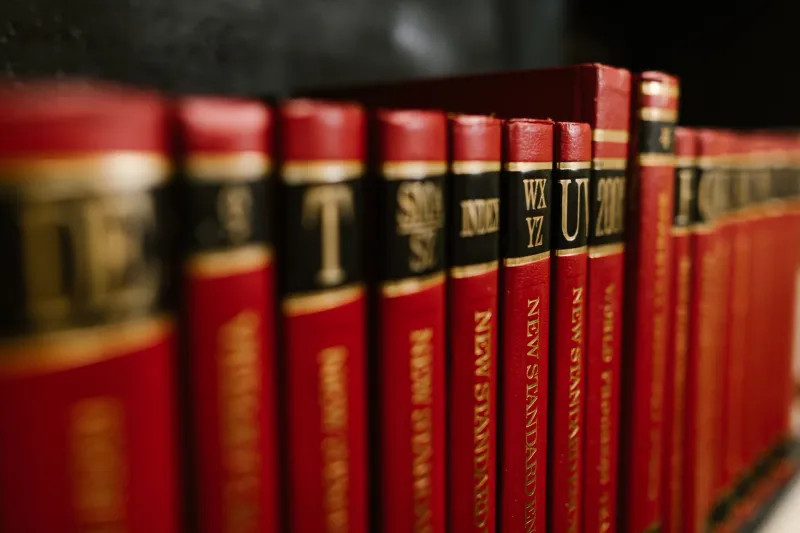
If you grew up in an American home in the 1960s, 70s, or 80s, there's a decent chance you remember them. Thirty-some volumes, dark spines, gold lettering, lined up on a dedicated shelf like soldiers at attention. The Encyclopedia Britannica. Or maybe World Book. Or Collier's. Whatever the set, they occupied a specific place in the household — not just physically, but symbolically.
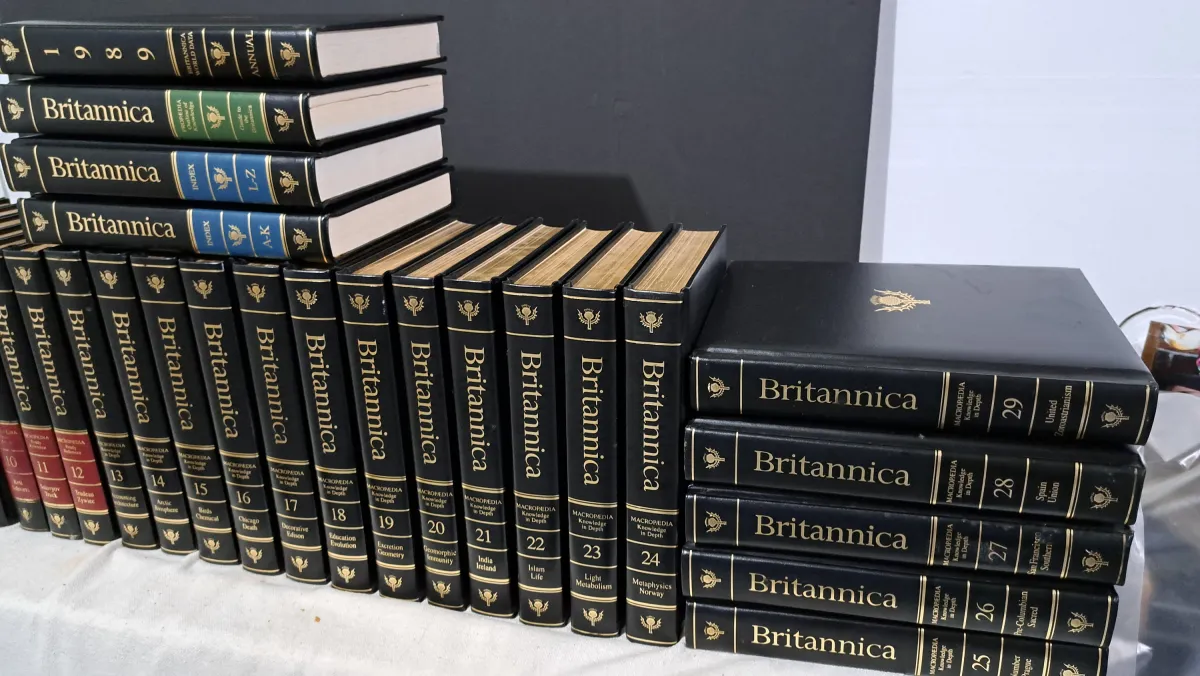 Photo: Encyclopedia Britannica, via i.etsystatic.com
They meant something. They were proof that your parents took your education seriously enough to make payments on it.
The Installment Plan Education
Here's a detail that tends to surprise people who didn't live through it: most families didn't buy encyclopedias outright. They financed them. A salesman — and yes, there were dedicated encyclopedia salesmen, often working door-to-door — would show up, spread out a sample volume on the kitchen table, and make a pitch that was equal parts product demonstration and emotional appeal.
The argument was almost always the same: your children deserve every advantage. And for parents who hadn't gone to college, or who had grown up in homes where books were scarce, that argument landed hard. A complete set of Britannica in the early 1970s could run $400 to $600 — the equivalent of well over $3,000 today. Families stretched their budgets to make it happen. The encyclopedias went on the shelf. And they stayed there, sometimes for decades.
That's not a small thing. This was a generation of Americans treating reference books the way a later generation would treat a 529 college savings plan.
The Ritual of Looking It Up
What's worth pausing on — what gets lost in any quick comparison to Google — is the actual experience of using those books.
Say you were twelve years old and needed to know the capital of Peru for a school report. You pulled the P volume off the shelf. It was heavy — genuinely heavy, a physical object with heft. You flipped through pages with that distinctive encyclopedia paper, slightly thinner than regular stock, dense with text and the occasional black-and-white photograph. You found Peru. You read the entry. And because you were already there, flipping through the P's, you probably skimmed past Petroleum, or Philadelphia, or the Peloponnesian War.
You didn't search for a single fact. You stumbled into a neighborhood of facts.
That's the part that's genuinely hard to replicate now. The act of looking something up was slow enough that curiosity had time to wander. You went in for one answer and came out knowing three things you hadn't planned to learn. The friction of the process was, paradoxically, part of what made it educational.
The Authority Problem — And Its Shadow
Encyclopedias also carried a specific kind of authority that no website has quite managed to replicate. If Britannica said it, it was settled. The encyclopedia was the final word at the dinner table, the end of the argument, the thing you could point to and say: look, it's right here.
That authority came from a real place — Britannica employed genuine subject experts, Nobel laureates among them, to write and review entries. The editorial process was rigorous by any standard. But it was also static. A 1974 edition couldn't tell you about anything that happened in 1975. The world kept moving; the books stayed put. Families would sometimes have a set that was fifteen years out of date, still being consulted as though it were current.
Wikipedia, for all the jokes made about its reliability, is updated in real time by thousands of contributors and flagged when sources are thin. It's less authoritative in the old sense — no gold lettering, no leather binding — but it's alive in a way those shelves never were.
What We Traded Away
The informational access we have today is, by any objective measure, extraordinary. The entire text of every encyclopedia ever published represents a tiny fraction of what a person can access from a phone in thirty seconds. Questions that once required a trip to the library or a fifteen-minute page-flip now resolve in the time it takes to type.
But there are a few things that dissolved in the transition.
One is the sense of effort as a signal of value. When finding information required physical engagement — pulling the volume, sitting down with it, reading around your target — you were more likely to remember what you found. Cognitive science backs this up: the more effort we invest in acquiring information, the more firmly it tends to stick. Frictionless access, it turns out, can produce frictionless retention.
Another is the shared household relationship with knowledge. Those encyclopedias were communal objects. A family of five all used the same set, argued over the same entries, wrote notes in the margins. There was something grounding about that — information as a shared physical resource rather than a private, personalized feed.
The Shelf Is Still There
In a lot of older homes across the country, the encyclopedia set is still on the shelf. Not because anyone consults it, but because it feels wrong to throw it away. It meant too much when it arrived. It cost too much, in both money and aspiration, to simply discard.
That might be the most telling detail of all. We've moved on to something faster, broader, and almost incomprehensibly more powerful. But those dark spines with the gold lettering still carry a weight that no browser tab has ever quite matched.