Your Great-Grandmother Didn't 'Go Grocery Shopping' — She Ran Errands All Morning
Your Great-Grandmother Didn't 'Go Grocery Shopping' — She Ran Errands All Morning
Picture a Tuesday morning in 1920s America. A woman leaves her house with a basket and a mental list. First stop: the butcher, two blocks over, where the cuts are chalked on a board and the guy behind the counter knows her name and her usual order. Then the bakery, where the bread came out of the oven an hour ago. Then the icehouse, or a quick check on the icebox delivery schedule. Maybe a stop at the greengrocer for whatever's in season. If she needs dry goods — flour, sugar, canned beans — there's a general store for that.
She doesn't call this "grocery shopping." She just calls it the morning.
A Town Built Around the Business of Feeding Itself
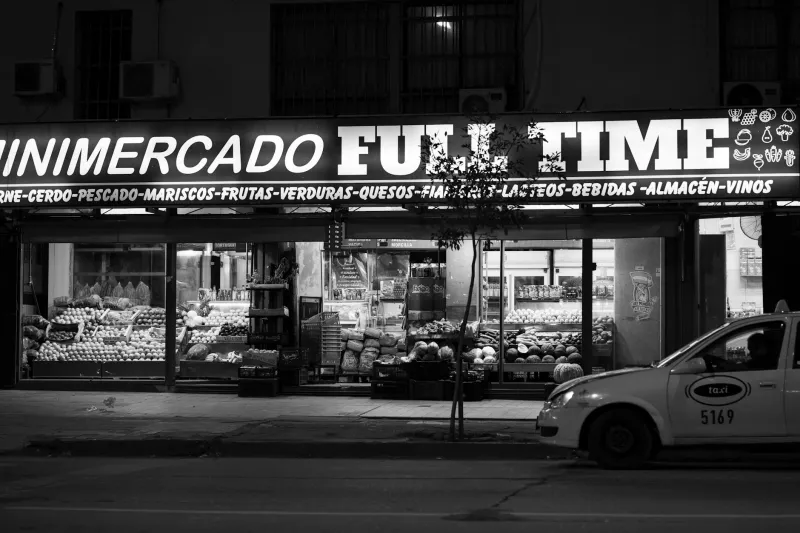
For most of American history, buying food was a distributed, relationship-driven activity. Different products came from different specialists, and those specialists were woven into the fabric of neighborhood life in ways that a modern Kroger simply isn't.
The butcher knew which cuts were fresh that day and which to avoid. The greengrocer could tell you that the tomatoes weren't worth it this week but the corn was exceptional. These weren't just transactions — they were small exchanges of local knowledge, repeated daily, that helped people eat better and waste less.
Many urban neighborhoods also had home delivery infrastructure that would look surprisingly modern on paper. Milkmen made morning rounds before dawn. Bread trucks followed regular routes. Depending on the city, you might also receive regular deliveries of eggs, ice, and even coal. The supply chain came to your door — it just came in pieces, from multiple sources, on different days.
The Supermarket Arrives — and Changes Everything
The first true self-service grocery store in the United States is generally credited to Clarence Saunders, who opened a Piggly Wiggly in Memphis, Tennessee, in 1916. The concept was genuinely radical: instead of asking a clerk to retrieve items for you from behind a counter, customers walked through the store themselves, picked their own products off shelves, and paid at a register on the way out.
It sounds completely unremarkable today. At the time, it was a sensation.
But the format that most Americans would recognize — the large, multi-department supermarket selling meat, produce, dairy, and dry goods all under one roof — didn't really take hold until the 1930s and 1940s. King Kullen, which opened in Queens, New York in 1930, is widely considered the first true supermarket in the modern sense. It was enormous by the standards of the time, and it used bulk purchasing and low margins to undercut every specialist shop in the area.
The model spread fast. By the 1950s, the supermarket was becoming the dominant food retail format across the country, accelerated by postwar suburbanization, the rise of the automobile, and the refrigerator's arrival in American homes. Suddenly, you could buy a week's worth of food in a single trip. The morning errand circuit began to disappear.
What Got Lost in the Aisles
The efficiency gains were real and significant. A single shopping trip replaced five or six separate stops. Refrigeration extended the life of perishables. Standardized packaging made comparison shopping easier. Food became more accessible and, in many ways, more affordable.
But the consolidation had costs that took decades to fully surface.
The small specialist shops that defined neighborhood food culture didn't survive the supermarket era in most American cities. The butcher who knew your order, the baker whose bread was still warm — these became rare luxuries rather than neighborhood fixtures. The social texture of the daily food run, those small repeated interactions with local merchants, dissolved into the anonymous efficiency of the supermarket aisle.
Diet shifted too, in ways that weren't entirely positive. Supermarkets incentivized shelf-stable, processed products that could be stocked in quantity and sold with long lead times. The fresh, seasonal, locally-sourced quality of the old specialist model gave way to a system optimized for scale and consistency over freshness and variety.
One Click, Delivered by Tomorrow
The story didn't stop with the supermarket. The 1990s brought big-box retailers like Walmart and Costco, which pushed the model further toward volume and price. Then came the internet, and with it, the first wave of online grocery experiments — most of which failed spectacularly in the dot-com bust.
But the idea survived. Amazon Fresh, Instacart, and a wave of delivery apps eventually cracked the code. The COVID-19 pandemic accelerated online grocery adoption by years in a matter of months. Today, roughly 25% of American households buy groceries online at least occasionally, and that number continues to grow.
We've gone from a model where food shopping was a daily, neighborhood-based, human activity to one where an algorithm can predict what you're running low on and schedule a delivery before you've noticed. The shopper who spent her Tuesday mornings moving through a network of local merchants would find the modern experience almost incomprehensible — not just the technology, but the total absence of conversation, relationship, and community embedded in the act of buying food.
The Aisle We're Still Walking Down
There's a reason the farmers' market has made such a strong comeback in American cities over the past two decades. It's not just about organic produce or artisan bread. It's about recovering something that the efficiency of the supermarket quietly took away — the sense that buying food is a social act, embedded in a community, shaped by seasons and relationships and local knowledge.
The supermarket didn't just change where Americans shop. It changed how they relate to the food they eat and the people who produce it. That shift happened fast, within living memory, and most of us absorbed it without a second thought.
The basket your great-grandmother carried down the block every morning was doing more work than it looked like.